JINI ENTERPRISE | www.jinienterprise.in
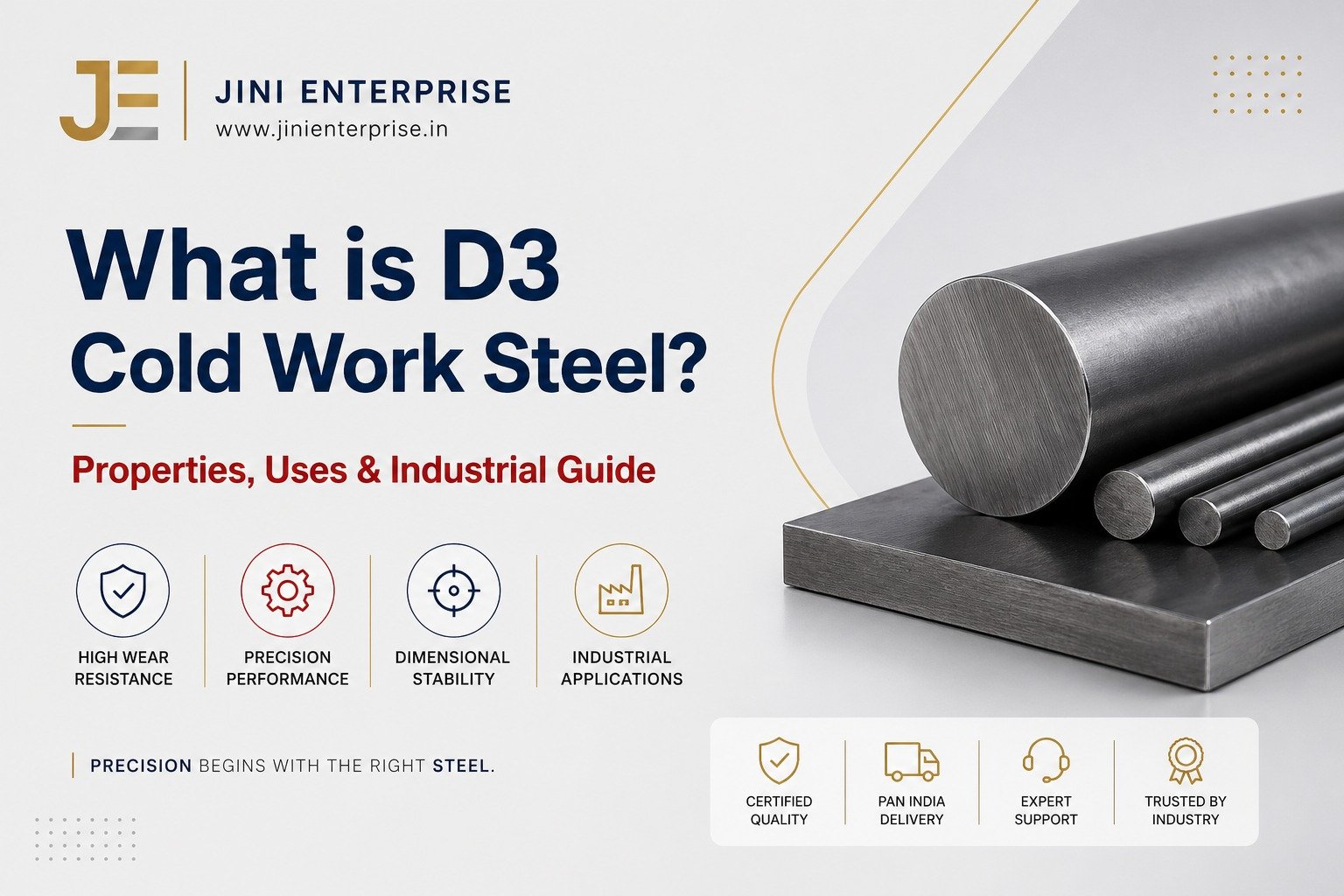
What is D3 Cold Work Steel?
Properties, Uses & Industrial Guide
"Precision Begins with the Right Steel --- Trust Jini Enterprise"
Introduction
Choosing the right steel grade can make or break your tooling performance. D3 Cold Work Steel is one of the most trusted high-carbon, high-chromium tool steels for cold working --- offering extreme hardness, superior wear resistance, and long die life. This guide covers everything you need to know about D3, and how it compares to H13 hot die steel for different applications.
What is D3 Cold Work Steel?
D3 is an AISI/SAE D-series high-carbon, high-chromium tool steel built for cold working operations --- processes performed at or near room temperature. With 2.0--2.35% carbon and 11--13.5% chromium, it delivers unmatched hardness (58--63 HRC) and abrasion resistance, making it the preferred choice for dies, punches, and cutting tools.
Chemical Composition
- Carbon (C): 2.00--2.35% --- High hardness and wear resistance
- Chromium (Cr): 11.0--13.5% --- Hardenability and corrosion resistance
- Vanadium (V): 0.50--1.00% --- Refined grain, better wear resistance
- Manganese (Mn): 0.10--0.60% --- Improved strength
- Silicon (Si): 0.10--0.60% --- Steel quality and deoxidization
- Phosphorus & Sulfur: Max 0.030% each --- Controlled for toughness
Key Properties of D3 Cold Work Steel
Hardness: 58--63 HRC
One of the hardest tool steels available. Maintains cutting edge and shape under heavy compressive loads.
Outstanding Wear Resistance
High carbon + chromium = exceptional resistance to abrasion. Ideal for blanking, punching, and shearing.
High Compressive Strength
Withstands enormous forming forces without deforming --- critical for cold stamping and die work.
Dimensional Stability
Oil or air-quenched during heat treatment, reducing distortion. Tools hold tight tolerances throughout their service life.
Moderate Toughness
Trade-off for high hardness. D3 is not suited for heavy impact loads --- use H13 hot die steel for those applications.
Heat Treatment --- Quick Guide
- Anneal: 850--900°C, slow furnace cool --- for machining
- Harden: Austenitize at 950--1000°C
- Quench: Oil quench or air cool
- Temper: 150--250°C immediately after quenching
Tip: Protect surfaces during heating to prevent decarburization. EDM is ideal for complex shapes --- always temper after EDM.
Industrial Uses & Applications
- Blanking & Stamping Dies --- Precision sheet metal processing
- Cold Forming & Drawing Tools --- Deep drawing punches and dies
- Shear Blades & Slitters --- Long-lasting cutting tools
- Precision Gauges & Templates --- Dimensionally stable measuring tools
- Thread Rolling Dies --- High-volume thread forming
- Cold Extrusion Punches --- High compressive load resistance
D3 Cold Work Steel vs H13 Hot Die Steel
Two premium steels --- two very different jobs. Here's a quick side-by-side:
| Property | D3 Cold Work Steel | H13 Hot Die Steel |
|---|---|---|
| Carbon | 2.0--2.35% | 0.32--0.45% |
| Chromium | 11--13.5% | 4.75--5.5% |
| Hardness (HRC) | 58--63 | 44--52 |
| Max Temp | ~250°C | ~600°C |
| Wear Resistance | Excellent | Good |
| Toughness | Moderate | High |
| Best For | Blanking, stamping dies | Die casting, forging |
Choose D3 When:
- Operations run at room temperature
- Maximum wear resistance is the top priority
- Tight dimensional tolerances are required
- Applications involve blanking, punching, or cold forming
Choose H13 Hot Die Steel When:
- Tooling is exposed to temperatures above 300°C
- High toughness and thermal fatigue resistance are needed
- Applications include die casting, hot forging, or hot extrusion
- H13 steel properties like heat checking resistance are critical
H13 Hot Die Steel --- Properties & Uses
H13 is the global benchmark for hot work tooling. Its chromium-molybdenum-vanadium composition delivers superior toughness, heat resistance up to 600°C, and excellent thermal fatigue resistance --- making it indispensable for high-temperature applications.
H13 Steel Properties
- Carbon: 0.32--0.45% | Chromium: 4.75--5.5% | Molybdenum: 1.10--1.75%
- Vanadium: 0.80--1.20% | Hardness: 44--52 HRC
- Working temp: Up to 550--600°C with retained hardness
- Excellent resistance to heat checking and thermal shock
Hot Die Steel Uses
- Aluminum & magnesium die casting dies
- Hot forging dies and inserts
- Plastic injection molds (high-volume)
- Hot extrusion tools, mandrels, and cores
- Die casting core pins and ejector pins
Why Choose Jini Enterprise?
- Certified Quality: D3 and H13 meeting AISI, DIN & BS standards
- Wide Range: Bars, plates, and custom-cut tool steels
- Technical Support: Grade selection guidance for your exact application
- Competitive Pricing: Quality material at market-best rates
- Pan-India Delivery: Serving tool rooms and manufacturers across India
- Value-Added Services: Cutting to size, surface grinding coordination
Quick FAQs
Blanking dies, punching dies, shear blades, precision gauges, thread rolling dies, and cold extrusion punches.
D3 is optimized for cold work (room temperature, max hardness). H13 excels in hot work (up to 600°C, high toughness). Different temperature ranges, different jobs.
High hot hardness retention, superior toughness, excellent thermal fatigue resistance, and good oxidation resistance at elevated temperatures.
Not recommended due to high carbon content. If necessary: preheat to 300--400°C, use matching filler, and temper immediately after welding.
Jini Enterprise (www.jinienterprise.in) --- certified stock, pan-India delivery.
Conclusion
D3 Cold Work Steel is the go-to choice for precision cold work tooling --- unmatched in hardness and wear resistance. When high temperatures enter the picture, H13 hot die steel takes over with its exceptional toughness and thermal performance. Jini Enterprise stocks both grades and helps you pick the right one for your application.