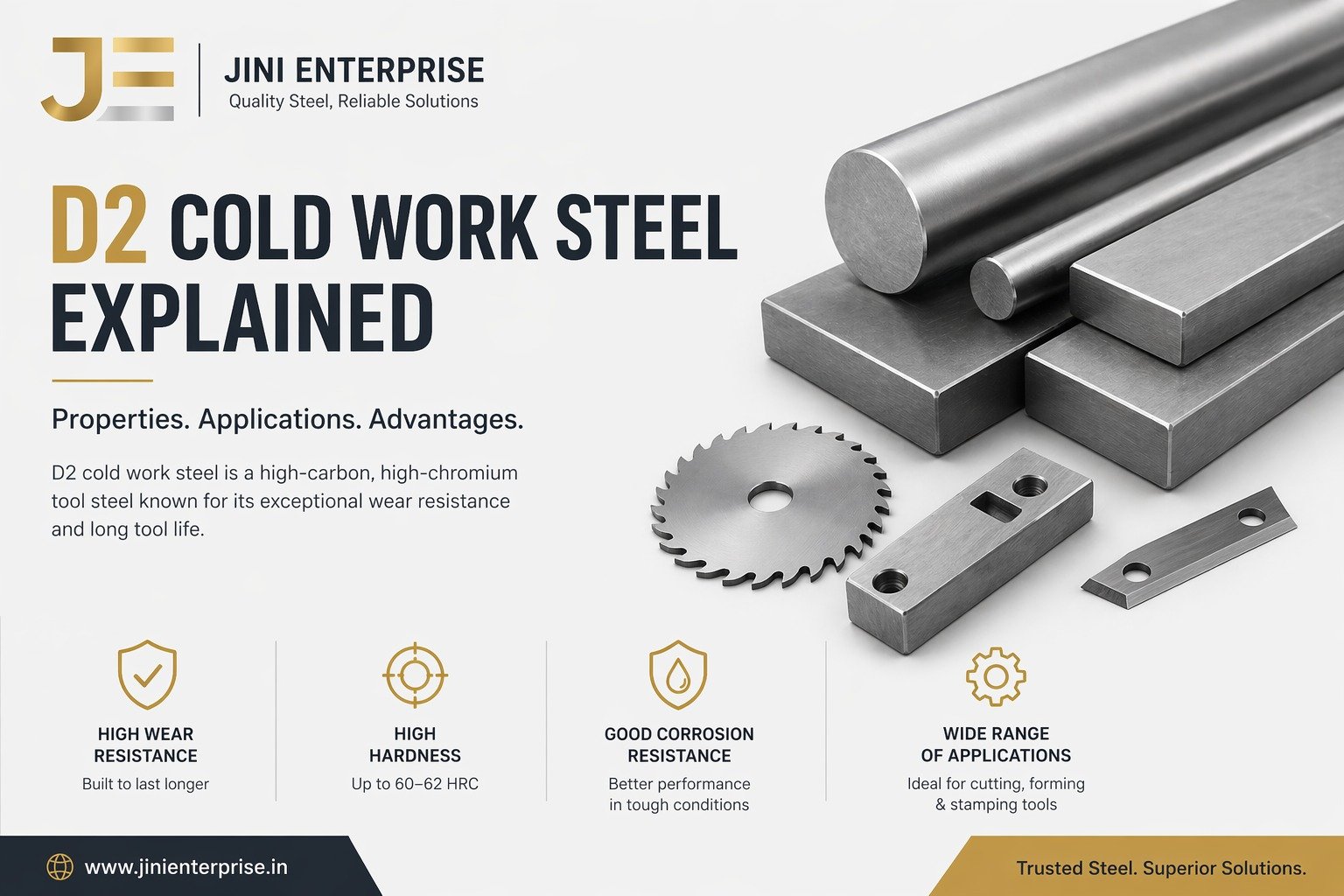
D2 Cold Work Steel Explained: Properties, Applications & Advantages
By Jini Enterprise | jinienterprise.in
If you figure in production, tooling, or industrial engineering, you've got almost without a doubt stumble upon the time period D2 cold work steel. It is one of the extensively used and depended on tool steels inside the enterprise — and for desirable reason. From stamping dies to reducing blades, D2 gives you an unprecedented mixture of hardness, wear resistance, and dimensional stability that very few substances can in shape.
In this manual, we spoil down the whole lot you want to recognize approximately D2 cold work steel — its composition, mechanical properties, key blessings, and real-global cold work metal makes use of — so you can make smarter fabric decisions on your next mission.
What Is D2 Cold Work Steel?
D2 cold work steel is a high-carbon, high-chromium device metallic that belongs to the "D" series of cold work die steels. It is assessed under the AISI/SAE fashionable and is widely identified globally for its excellent put on resistance and relatively high toughness for a metal in its elegance.
The "cold work" designation manner that D2 is engineered for packages in which the steel operates at or near room temperature — in preference to warm work steels, that are designed for improved-temperature environments. This makes it best for forming, blanking, punching, and reducing operations.
What sets D2 tool steel apart from different grades is its specific chemical composition:
- Carbon (C): 1.40–1.60%
- Chromium (Cr): 11.00–13.00%
- Molybdenum (Mo): 0.70–1.20%
- Vanadium (V): 0.50–1.10%
- Manganese (Mn): 0.60% max
- Silicon (Si): 0.60% max
The high chromium content material is mainly sizable. It gives D2 a semi-stainless person — that means it has better corrosion resistance than maximum tool steels, although it is not a totally stainless grade. Combined with high carbon, this consequences in a dense network of difficult carbides at some point of the metal matrix, that is the primary motive force of its terrific wear resistance.
Key Mechanical Properties of D2 Tool Steel
Understanding the mechanical houses of D2 cold work steel is crucial before deciding on it for any utility. Here is what makes this cloth stand out:
- Exceptional Hardness – D2 can achieve a hardness of 58–62 HRC (Rockwell C scale) after warmth remedy. This degree of hardness ensures that tools and dies crafted from D2 can withstand excessive-strain forming and reducing operations without deforming or dropping their facet.
- Outstanding Wear Resistance – Among cold work steels, D2 is ranked as one of the highest in phrases of damage resistance. The large quantity of chromium carbides in its microstructure acts like a reinforcement framework, resisting abrasion even underneath prolonged operational cycles. This makes D2 cold work steel a go-to preference for lengthy-run dies and punches.
- High Compressive Strength – D2 is great in compressive energy, which means that it resists deformation below heavy hundreds. This property is critical for stamping and blanking operations wherein the metal is subjected to big, repetitive effect forces.
- Good Dimensional Stability During Heat Treatment – One of the maximum underrated characteristics of D2 cold work steel is its minimal distortion at some point of hardening. Thanks to its air-hardening feature, elements crafted from D2 preserve their form and dimensions plenty better than oil-quenched steels. This substantially reduces post-heat-remedy machining and remodel.
- Moderate Toughness – While D2 isn't always the toughest metallic inside the tooling own family, it offers adequate toughness for most cold work packages while properly warmth dealt with. Tempering at the correct temperature is vital to stability hardness with sturdiness and save you premature cracking.
- Decent Machinability – Compared to steels with similar hardness and carbide content material, D2 offers affordable machinability in its annealed circumstance, making it practical for precision toolmaking.
Heat Treatment Process for D2 Cold Work Steel
Proper warmness treatment is important to unlocking the entire overall performance capability of D2 cold work steel. Here is the standard system:
- Annealing: Heat to 870–900°C, keep, and sluggish-cool inside the furnace. This softens the metal for machining.
- Hardening (Austenitizing): Heat to 1000–1050°C.
- Quenching: Air cool or use a pressurized fuel quench. D2 is an air-hardening metal, that's certainly one of its key benefits over oil-quenching grades.
- Tempering: Temper right now after quenching at one hundred fifty–540°C relying on the specified hardness and sturdiness stability. Double tempering is recommended for optimum balance.
For greater technical steerage on heat remedy parameters, assets like ASM International and Uddeholm provide distinct metallurgical information sheets.
Cold Work Steel Uses: Where Is D2 Applied?
The versatility of D2 cold work steel shows up throughout a wide variety of industries. Below are the maximum not unusual and important cold paintings metal makes use of:
- Blanking and Punching Dies: D2 is the same old fabric for blanking dies utilized in sheet metal operations. Its wear resistance guarantees those dies can run for thousands and thousands of cycles earlier than requiring replacement or reconditioning.
- Forming Dies: Complex forming dies that require specific dimensional accuracy and consistent performance over lengthy manufacturing runs benefit relatively from D2's stability and hardness.
- Shear Blades and Slitter Knives: Industrial shear blades and slitter knives made from D2 tool steel maintain their sharp cutting area far longer than blades crafted from conventional excessive-velocity metal or lower-alloy grades. This reduces downtime and improves manufacturing efficiency.
- Cold Extrusion Tooling: In cold extrusion techniques, tooling is subjected to intense compressive loads. D2's high compressive power and put on resistance make it a dependable desire for mandrels, punches, and extrusion dies.
- Thread Rolling Dies: D2 cold work steel is extensively used for thread rolling dies due to the fact the manner needs a fabric which could deal with cyclic pressure without floor fatigue or wear-associated failure.
- Gauges and Measuring Tools: The dimensional balance and hardness of D2 make it a first-rate desire for precision gauges and inspection equipment that must keep their geometry over years of use.
- Plastic Mold Components (Low-to-Medium Volume): In certain programs where moderate volumes are predicted, D2 is used for injection mold cores and cavities — in particular while the plastic cloth is abrasive or glass-stuffed.
- Woodworking and Cutting Tools: Industrial timber-reducing blades, chipper knives, and planer blades regularly use D2 tool steel due to its ability to preserve a part towards the abrasive nature of wooden, in particular hardwoods and particleboard.
Advantages of D2 Cold Work Steel
Why do producers and toolmakers continually choose D2 cold work steel over different alternatives? Here are the core blessings that specify its enduring recognition:
- ✅ Longer Tool Life: The high carbide content material in D2 interprets directly into equipment that closing longer among re-sharpening or replacements. For excessive-extent production, this is a significant value benefit.
- ✅ Air Hardening Reduces Distortion: Because D2 hardens in air instead of oil, there may be a long way less thermal shock at some stage in quenching. This effects in minimal warping and distortion, that's particularly vital for precision tooling with tight tolerances.
- ✅ Better Corrosion Resistance Than Standard Tool Steels: With 11–13% chromium, D2 tool metal resists floor oxidation and light corrosion better than most other tool steels. This extends the garage life of finished gear and reduces the want for shielding coatings.
- ✅ Consistent Performance at High Production Volumes: D2 is depended on in high-volume stamping and forming environments because it grants regular outcomes over thousands and thousands of cycles, keeping dimensional accuracy and floor finish exceptional all through its carrier existence.
- ✅ Wide Availability and Proven Track Record: D2 cold work steel has been used in business tooling for decades. Its properties are well-documented, its behavior at some point of machining and heat remedy is predictable, and it's far supported through a mature deliver chain.
D2 vs. Other Cold Work Steels: How Does It Compare?
| Property | D2 | O1 | A2 | D3 |
|---|---|---|---|---|
| Wear Resistance | ★★★★★ | ★★★ | ★★★★ | ★★★★★ |
| Toughness | ★★★ | ★★★★ | ★★★★ | ★★ |
| Distortion in HT | Very Low | High | Low | High |
| Corrosion Resistance | Moderate | Low | Low | Low |
| Machinability | Moderate | Good | Good | Poor |
As seen above, D2 tool steel strikes the satisfactory overall balance for maximum bloodless paintings applications, mainly wherein wear resistance and dimensional stability are the top priorities.
Tips for Working With D2 Cold Work Steel
Getting the high-quality out of D2 cold work steel requires interest to a few key practices:
- Preheat before hardening to avoid thermal shock and cracking, particularly in large cross-sections.
- Always double temper D2 after hardening to make sure whole transformation of retained austenite.
- Use carbide or CBN equipment for end machining within the hardened circumstance to obtain top-quality surface exceptional.
- Avoid grinding with immoderate warmness — D2 is touchy to grinding burns, that can introduce surface cracks or lessen floor hardness.
- Store nicely — despite the fact that D2 has higher corrosion resistance than well-known device steels, it needs to nonetheless be stored in dry surroundings and gently oiled when no longer in use.
At Jini Enterprise, we supply super D2 cold work steel and a comprehensive range of D2 steel to meet the needs of cutting-edge production. Our inventory is sourced from certified turbines and undergoes strict nice checks to make sure each piece you acquire meets the desired chemical composition, hardness specs, and dimensional tolerances.
Whether you need raw bar stock, forged blanks, or precision-cut pieces for unique tooling programs, Jini Enterprise has the know-how and inventory to aid your production necessities.
Visit us at www.jinienterprise.in to discover our complete range of tool steel products and call our technical crew for fabric hints tailor-made on your software.
Frequently Asked Questions (FAQs)
Q: Is D2 cold work steel similar to stainless-steel?
No. While D2 contains a high percentage of chromium (11–13%), it does not meet the thirteen% minimal threshold required to be categorized as true stainless-steel. It is better described as semi-stainless, imparting progressed corrosion resistance over trendy tool steels but no longer the whole protection of stainless grades.
Q: What is the everyday hardness of D2 after warmth remedy?
After proper hardening and tempering, D2 steel usually achieves 58–sixty two HRC, relying at the tempering temperature used.
Q: Can D2 be used for warm paintings applications?
No. D2 is particularly a chilly work grade and is not suitable for packages regarding extended temperatures. For warm paintings environments, grades like H13 or H11 are greater appropriate.
Q: What are the main bloodless work steel uses for D2 inside the automobile enterprise?
In car production, D2 is widely used for stamping dies, trim dies, and blanking dies used in the production of body panels, brackets, and structural additives.
Final Thoughts
D2 cold work steel remains one of the maximum dependable and broadly particular device steels in the world — and its music report speaks for itself. Its first-rate put-on resistance, air-hardening traits, dimensional balance, and versatility throughout an extensive variety of cold work metal uses make it a primary-choice material for critical toolmakers and producers.
Whether you're designing a new die set, changing worn tooling, or deciding on substances for a new production line, D2 tool metal deserves a near look. With the proper heat remedy and proper utility, it will supply remarkable performance and long service existence.
For sourcing, technical support, or custom supply necessities, consider Jini Enterprise — your dependable partner for premium tool steel answers.